









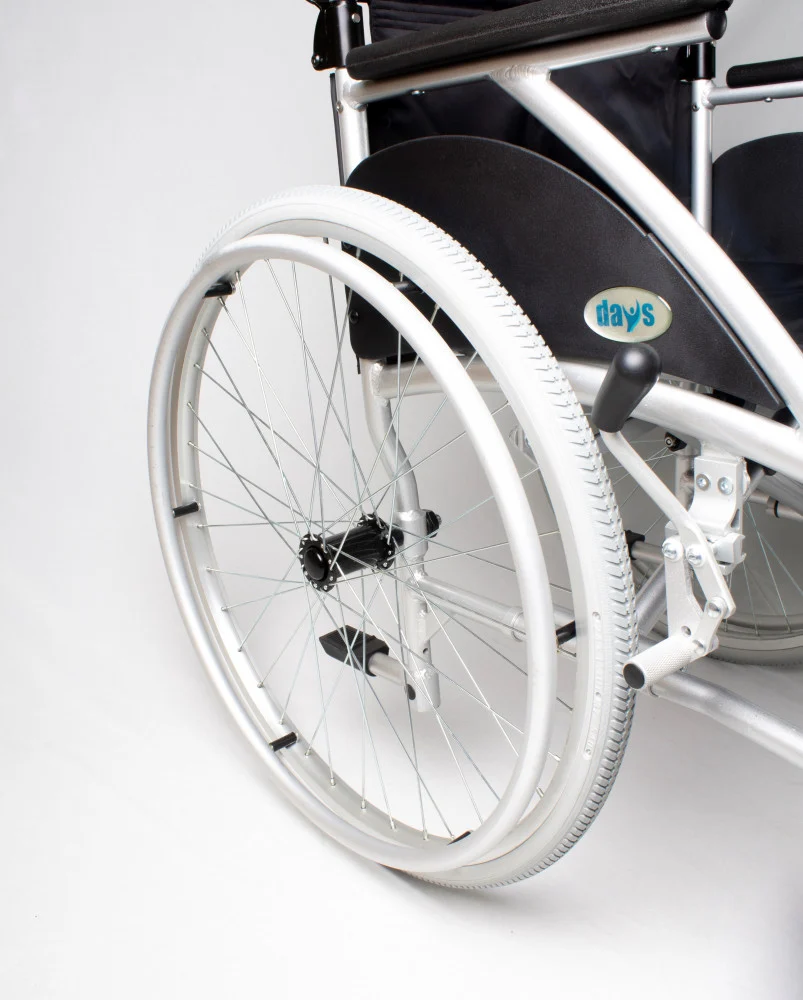
Days wheelchair, large cover




Delivery
Payment options
Our advantages
- Fast delivery
- Email notifications
- Different payment methods
- Competitive prices
Find similar
Description
• Lightweight, foldable wheelchair (14.5 kg) made of aluminum.
• Suitable for individuals who can propel themselves.
• Adjustable seat height (adjustment service is available from our maintenance team).
• Adjustable armrests with a layer of foam padding for added comfort.
• Adjustable footrests that can be raised and lowered and are also removable.
• Contoured backrest that conforms to the user's spine for enhanced comfort.
• Includes a foam seat cushion.
• Maximum user weight: 140 kg for small sizes and 180 kg for large sizes.
Puncture-resistant rubber tires.
********************************************************************************************************************
How to choose the right manual wheelchair?
Before we go into detail, it's important to know that there are generally two types of wheelchairs: manual wheelchairs and electric wheelchairs.
A manual wheelchair is suitable for users who can propel themselves independently, have assistance, need a wheelchair temporarily, use it infrequently, or require a lightweight, foldable wheelchair for easy transport and storage (for example, for loading into a car or airplane, or storing it at home after use).
An electric wheelchair, on the other hand, is suitable for users who cannot propel themselves independently or have assistance, and also for users who prefer freedom of movement, both at home and outdoors.
This article discusses how to choose the right manual wheelchair, its different types, and their various features.
To determine the appropriate manual wheelchair and avoid secondary injuries, the most important factor is understanding the user's mobility. Understanding this allows us to select the most suitable wheelchair and the best features to meet their specific needs.
To understand the user's mobility, we need to answer a few questions about the user:
Question 1: If the user can walk, do they need assistance when walking on uneven ground?
When walking on uneven ground, do the user need to use a cane, walker (or other walking aid) to help them maintain their balance and avoid falls?
If the user feels (and is confident) that these walking aids (cane, walker, etc.) are sufficient, they don't necessarily need to use a wheelchair. However, in some circumstances, a wheelchair may be appropriate, especially if the user is a child or an elderly person with cognitive impairment, as they may wander off and get lost easily when out of the sight of their family or caregivers.
Question 2: If the user can walk, do they need to hold onto or lean on stable objects around them to maintain their balance and feel secure?
For example, if a user is walking from the bedroom to the living room, do they lean on the walls, hold onto the back of the sofa, or grab a doorknob to balance and avoid falling? If so, they need a lightweight, foldable aluminum wheelchair.
This type of manual wheelchair is suitable for those with temporary injuries that make walking very difficult or impossible, such as fractures or leg surgeries, to name just a few.
It's also useful for elderly people with frailty who need to use a wheelchair intermittently, not constantly. They can walk with assistance at times and use the wheelchair at others.
In any case, if the wheelchair user will be sitting in it for more than half an hour a day, it's absolutely essential to use a special seat cushion, especially for elderly patients, because the pressure from sitting can lead to skin ulcers.
Prolonged sitting doesn't just affect the skin on the buttocks; pressure on the lower arms and back can also cause skin ulcers. That's why armrests and the backrest of the chair must be made of soft materials.
Third question: If the user can't walk, can they stand comfortably from a seated position?
If the wheelchair user can't stand up on their own, how will they transfer themselves to and from the chair? How will they move between the wheelchair and a bed, toilet seat, or car?
In all cases, whether they're independent or rely on someone to help or carry them, the armrests and leg rests (like those on the aluminum wheelchair mentioned above) will get in the way and make movement difficult.
Therefore, in this situation, the armrests and leg rests on the wheelchair must be removable or easy to detach and reattach quickly. This feature greatly simplifies the transfer process, as the patient doesn't need to stand. They simply detach the armrests, rotate the leg rests, and then transfer their body while seated, either independently or with assistance. This makes the process easier and faster, requiring less effort from both the user and their assistant.
Additionally, when the leg rests can be rotated inwards, storage becomes easier because the chair's size is reduced, requiring less storage space.
In addition to the above, some users are completely unable to walk, such as those with a spinal cord injury and paralysis of the legs, but whose upper body and arms are strong. These individuals are also naturally active and frequently move around. In this case, a sports wheelchair is the best option. This type of chair is very lightweight yet very sturdy, allowing for easy and quick movement.
The fourth and final question: If the user is unable to walk, do they need additional trunk support while seated in the chair?
If the user cannot sit independently in the wheelchair (leaning to one side or feeling like they might fall out), they need a special chair that supports their back and head while seated to prevent falls or injury.
This type of chair isIt has a long backrest, providing full support for the back and head. There are three types: a tilting wheelchair with a reclining seat, a reclining wheelchair with a fully reclining backrest that allows the patient to lie flat, and a third type that combines both features, so you can use either one.
The first type, when it reclines, reduces pressure on the user's buttocks and back, thus decreasing the likelihood of pressure sores.
The second type allows the patient to lie completely flat, making it easier for caregivers to perform tasks that are difficult to do while the patient is seated, such as changing diapers or cleaning with a wet sponge.
Summary
There's no such thing as the best wheelchair, but there are the most suitable wheelchairs. We've summarized the different types of manual wheelchairs, each suitable for various situations. If you're unsure which one to choose and need assistance, contact us. Our expert team is ready to help you select the most appropriate wheelchair.
General Wheelchair
Most commonly used in hospitals. Heavy and uncomfortable, not recommended for long journeys.
Aluminum Wheelchair
Lightweight and easy to carry. Suitable for those who can walk but have unsteady gait.
Mobility Wheelchair
Suitable for patients who cannot stand easily and need to transfer to and from the wheelchair frequently throughout the day. The leg and arm supports are detachable and adjustable, making transferring to and from the wheelchair easier and safer.
Sports Wheelchair
Best for patients who cannot walk but have a healthy and strong upper body. Lightweight, very durable, and quick to move.
Reclined Wheelchair
Suitable for patients who cannot sit independently. The reclined position allows the patient to partially recline without the risk of sliding forward and falling off the chair.
Reclined Wheelchair
Allows the patient to fully recline. Suitable for patients who cannot sit independently and require special care.
A reclining wheelchair with an adjustable backrest.
It allows the patient to lie partially or fully, suitable for all patients with upper body limitations.
• Suitable for individuals who can propel themselves.
• Adjustable seat height (adjustment service is available from our maintenance team).
• Adjustable armrests with a layer of foam padding for added comfort.
• Adjustable footrests that can be raised and lowered and are also removable.
• Contoured backrest that conforms to the user's spine for enhanced comfort.
• Includes a foam seat cushion.
• Maximum user weight: 140 kg for small sizes and 180 kg for large sizes.
Puncture-resistant rubber tires.
********************************************************************************************************************
How to choose the right manual wheelchair?
Before we go into detail, it's important to know that there are generally two types of wheelchairs: manual wheelchairs and electric wheelchairs.
A manual wheelchair is suitable for users who can propel themselves independently, have assistance, need a wheelchair temporarily, use it infrequently, or require a lightweight, foldable wheelchair for easy transport and storage (for example, for loading into a car or airplane, or storing it at home after use).
An electric wheelchair, on the other hand, is suitable for users who cannot propel themselves independently or have assistance, and also for users who prefer freedom of movement, both at home and outdoors.
This article discusses how to choose the right manual wheelchair, its different types, and their various features.
To determine the appropriate manual wheelchair and avoid secondary injuries, the most important factor is understanding the user's mobility. Understanding this allows us to select the most suitable wheelchair and the best features to meet their specific needs.
To understand the user's mobility, we need to answer a few questions about the user:
Question 1: If the user can walk, do they need assistance when walking on uneven ground?
When walking on uneven ground, do the user need to use a cane, walker (or other walking aid) to help them maintain their balance and avoid falls?
If the user feels (and is confident) that these walking aids (cane, walker, etc.) are sufficient, they don't necessarily need to use a wheelchair. However, in some circumstances, a wheelchair may be appropriate, especially if the user is a child or an elderly person with cognitive impairment, as they may wander off and get lost easily when out of the sight of their family or caregivers.
Question 2: If the user can walk, do they need to hold onto or lean on stable objects around them to maintain their balance and feel secure?
For example, if a user is walking from the bedroom to the living room, do they lean on the walls, hold onto the back of the sofa, or grab a doorknob to balance and avoid falling? If so, they need a lightweight, foldable aluminum wheelchair.
This type of manual wheelchair is suitable for those with temporary injuries that make walking very difficult or impossible, such as fractures or leg surgeries, to name just a few.
It's also useful for elderly people with frailty who need to use a wheelchair intermittently, not constantly. They can walk with assistance at times and use the wheelchair at others.
In any case, if the wheelchair user will be sitting in it for more than half an hour a day, it's absolutely essential to use a special seat cushion, especially for elderly patients, because the pressure from sitting can lead to skin ulcers.
Prolonged sitting doesn't just affect the skin on the buttocks; pressure on the lower arms and back can also cause skin ulcers. That's why armrests and the backrest of the chair must be made of soft materials.
Third question: If the user can't walk, can they stand comfortably from a seated position?
If the wheelchair user can't stand up on their own, how will they transfer themselves to and from the chair? How will they move between the wheelchair and a bed, toilet seat, or car?
In all cases, whether they're independent or rely on someone to help or carry them, the armrests and leg rests (like those on the aluminum wheelchair mentioned above) will get in the way and make movement difficult.
Therefore, in this situation, the armrests and leg rests on the wheelchair must be removable or easy to detach and reattach quickly. This feature greatly simplifies the transfer process, as the patient doesn't need to stand. They simply detach the armrests, rotate the leg rests, and then transfer their body while seated, either independently or with assistance. This makes the process easier and faster, requiring less effort from both the user and their assistant.
Additionally, when the leg rests can be rotated inwards, storage becomes easier because the chair's size is reduced, requiring less storage space.
In addition to the above, some users are completely unable to walk, such as those with a spinal cord injury and paralysis of the legs, but whose upper body and arms are strong. These individuals are also naturally active and frequently move around. In this case, a sports wheelchair is the best option. This type of chair is very lightweight yet very sturdy, allowing for easy and quick movement.
The fourth and final question: If the user is unable to walk, do they need additional trunk support while seated in the chair?
If the user cannot sit independently in the wheelchair (leaning to one side or feeling like they might fall out), they need a special chair that supports their back and head while seated to prevent falls or injury.
This type of chair isIt has a long backrest, providing full support for the back and head. There are three types: a tilting wheelchair with a reclining seat, a reclining wheelchair with a fully reclining backrest that allows the patient to lie flat, and a third type that combines both features, so you can use either one.
The first type, when it reclines, reduces pressure on the user's buttocks and back, thus decreasing the likelihood of pressure sores.
The second type allows the patient to lie completely flat, making it easier for caregivers to perform tasks that are difficult to do while the patient is seated, such as changing diapers or cleaning with a wet sponge.
Summary
There's no such thing as the best wheelchair, but there are the most suitable wheelchairs. We've summarized the different types of manual wheelchairs, each suitable for various situations. If you're unsure which one to choose and need assistance, contact us. Our expert team is ready to help you select the most appropriate wheelchair.
General Wheelchair
Most commonly used in hospitals. Heavy and uncomfortable, not recommended for long journeys.
Aluminum Wheelchair
Lightweight and easy to carry. Suitable for those who can walk but have unsteady gait.
Mobility Wheelchair
Suitable for patients who cannot stand easily and need to transfer to and from the wheelchair frequently throughout the day. The leg and arm supports are detachable and adjustable, making transferring to and from the wheelchair easier and safer.
Sports Wheelchair
Best for patients who cannot walk but have a healthy and strong upper body. Lightweight, very durable, and quick to move.
Reclined Wheelchair
Suitable for patients who cannot sit independently. The reclined position allows the patient to partially recline without the risk of sliding forward and falling off the chair.
Reclined Wheelchair
Allows the patient to fully recline. Suitable for patients who cannot sit independently and require special care.
A reclining wheelchair with an adjustable backrest.
It allows the patient to lie partially or fully, suitable for all patients with upper body limitations.
Features
Brand
days
مقاس الكرسي
مقاس 46
Reviews
No reviews found
Please sign in so that we can notify you about a reply